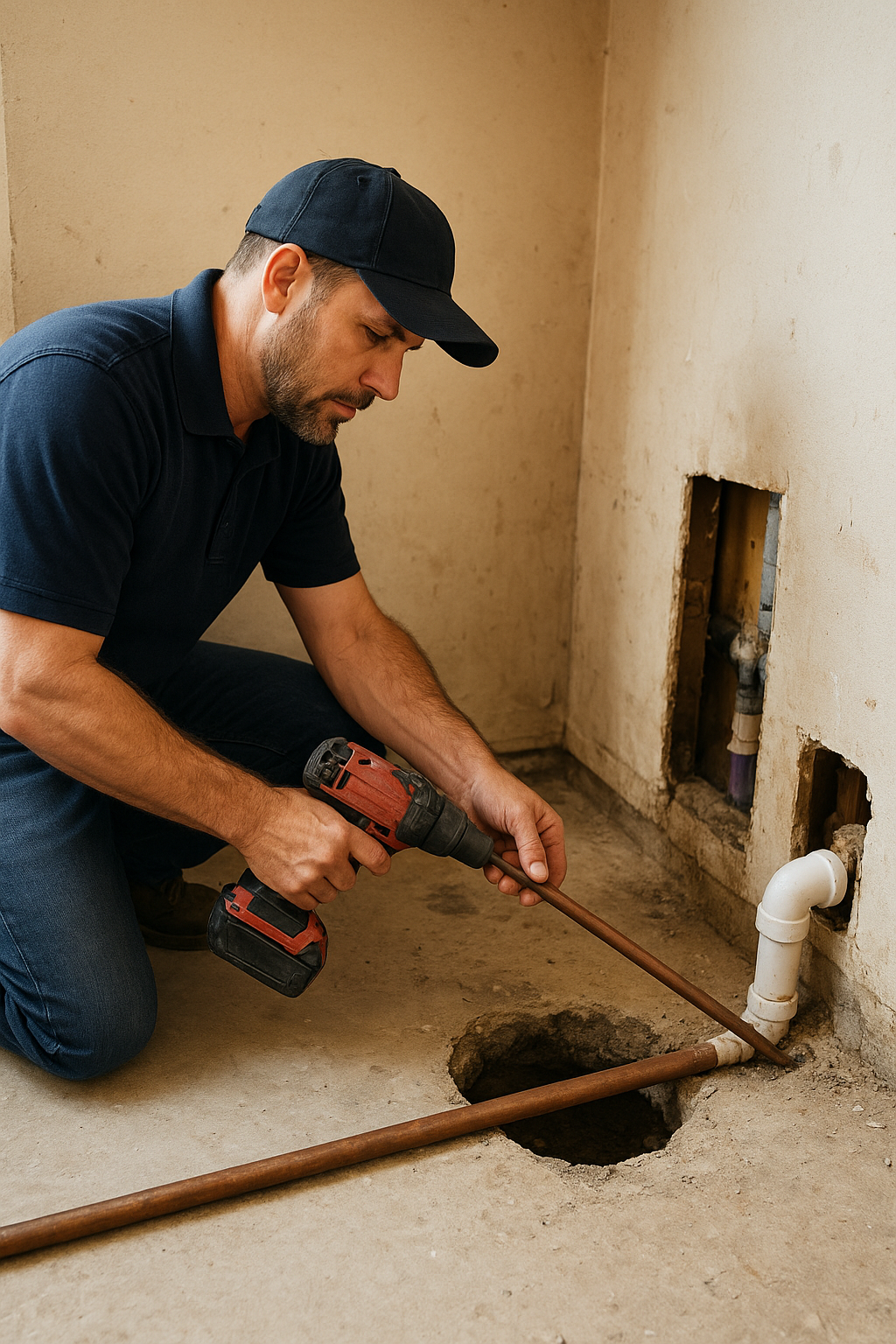
Las Vegas sits on alkaline desert soils that accelerate corrosion on older copper lines running under slabs, especially in homes built from the 1970s through the early 2000s in neighborhoods such as Spring Valley and Sunrise Manor. Once a pinhole leak develops, hot summer ground temperatures speed up water loss and can lift sections of the slab as moisture migrates. We map the leak with acoustic and camera equipment, then decide whether to reroute through walls or replace the entire under-slab run with PEX or type-L copper sleeved in conduit.
Clark County code requires that any new supply lines under a slab be installed in a way that allows future access or be sleeved, and we follow those rules on every job. In Centennial Hills and Lone Mountain, newer tracts often have post-tension cables that limit where we can trench; we work around them by pulling new lines through existing sleeves or creating minimal access pits. Homeowners in the Arts District and Downtown frequently request full under-slab repipes when they remodel because the original galvanized or thin-wall copper has already shown multiple failures.
Mild winters mean we rarely deal with freeze damage, but the extreme heat causes pipe expansion and contraction that loosens fittings over decades. We always pressure-test the new system to 100 psi for a full day before restoring the slab so there are no hidden leaks under finished floors.
When the job involves the whole house, we coordinate with concrete cutters who understand how to avoid rebar and tension cables common in Clark County slabs. This keeps the restoration clean and prevents callbacks during the next monsoon season when groundwater can rise.
Technician insight
In Las Vegas the thing that catches most people out with slab leaks is how fast alkaline soil eats through copper once the protective coating is gone; homes in Spring Valley and Sunrise Manor from the 80s and 90s are especially prone because the original installers often skipped sleeves. The heat expansion here also works fittings loose over time, so we always test longer than most crews do elsewhere.
Summerlin Home With Recurring Slab Leak
A 1998 Summerlin house showed repeated low water pressure and damp carpet edges. We located two pinhole leaks on the main cold line under the living room slab. We abandoned the old copper, pulled new PEX through conduit sleeves we created at the perimeter, and restored the floor in two days so the owners could finish their remodel without further water loss.
Slab Leak & Under-Slab Repipe Services We Offer
✓Slab Leak Detection
We use acoustic sensors and video scoping to locate leaks under concrete without random demolition in Las Vegas homes.
✓Under-Slab Copper Repipe
Full replacement of corroded copper lines with new type-L copper sleeved for protection against alkaline Clark County soils.
✓PEX Under-Slab Installation
Rerouting supply lines with PEX-A tubing in conduit where access allows, common in Summerlin and Enterprise tract homes.
✓Whole-House Under-Slab Repipe
Complete removal of failing under-slab piping and installation of new manifold system routed through walls or sleeves.
✓Slab Access and Restoration
Minimal concrete removal, proper backfill, and patch work that matches existing finishes in neighborhoods like Chinatown and the Strip corridor.
Slab Leak & Under-Slab Repipe Cost in Las Vegas, NV
| Service | Typical Range | What Affects It |
|---|---|---|
| Slab leak detection only | $350–$650 | Higher when multiple leaks or post-tension cables complicate access |
| Partial under-slab repipe | $1,800–$3,500 | One to three lines in accessible areas |
| Whole-house under-slab repipe | $4,800–$8,200 | Varies with square footage and whether walls must be opened for reroutes |
| Concrete restoration per pit | $450–$750 | Includes patch and finish to match existing flooring |
Ranges are typical for Las Vegas, NV and confirmed with an exact written quote before any work starts.
How it works
- 1
Leak Assessment
We inspect the home, review water bills, and use listening equipment to pinpoint the leak location under the slab.
- 2
Access Planning
We map post-tension cables and utilities, then mark the least invasive entry points that still allow full pipe replacement.
- 3
Pipe Replacement
Old lines are removed or abandoned and new PEX or copper is pulled through sleeves or new trenches with proper slope and supports.
- 4
Testing And Restoration
The new system is pressure tested, then concrete is restored and finished to match surrounding surfaces.
Pricing
Pricing depends on home size, number of access points needed, and whether the entire system or only affected lines are replaced.